

We all know that plain old-fashioned worked best according to their suitable era, but these models, which are also known as POTS, are facing a decline now. New technology, which is also known as copper sunset, is a new technology replacing the old copper wire telephone service, and the FCC is speeding things up. In 2025, the FCC issued new changes to how POTS networks are regulated, taking them even closer to retirement. If you are a business owner still operating on a POTS network, then it’s a perfect time to make a move to new, upgraded technology.
Now, IP phone service and IP phones for business entered the game. Instead of using a landline or a public Wi-Fi network to make calls, business ip phones connect to a private internet or local area network (LAN), making your calls easy, cost-effective, and giving you power and control over your data. Businesses looking for reliable voip phone systems sacramento are increasingly shifting toward IP-based solutions for better call quality, scalability, and long-term cost savings. Keep reading to learn more about what an internet phone is, how it works, and its benefits.
What is an IP phone?
An IP phone is basically a phone system that works over the internet, also called an internet phone or an internet protocol phone. It converts audio calls and data into digital signals that travel through a VoIP system and land on a local or private network where the person on the other side can hear them clearly. With modern technological advancements, an IP phone system is much more compatible with software, offering greater flexibility and control.
Types of IP Phones for Business
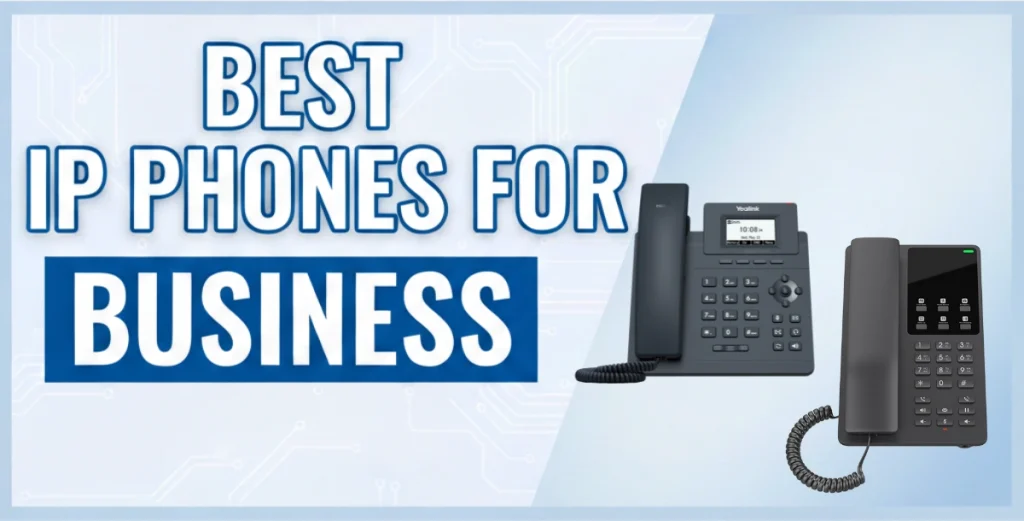
There are different types of IP phone systems that your business will find very suitable, these include:
- Desk IP phones.
- Cordless business IP phones.
- Softphones (mobile apps instead of a physical phone).
- Conference IP phones.
How Does an IP Phone System Work?
Unlike other traditional phones, Internet phones work by sending calls over the Internet, not a copper landline or a cellular network. They work by compressing voice signals from the phone, and then it converts it into digital signals. Those digital signals then travel through the VoIP network and into a private or a local area network. On the other hand, the one who receives it as a file, and those files are then decompressed and changed back to their normal-sounding audio for the listener to understand.
The IP Phone Difference
Internet protocol phones use technology that operates over the internet, not Wi-Fi or a landline. If you face VoIP System problems, we have compiled tips for you to try and save spending money on an IT guy. This technology is both dependable and pocket-friendly. We are explaining below:
- IP phone vs. a landline
An IP phone system influences IP (Internet Protocol) technology and is used within a single location or various locations on a private data network. IP phones for business are often used in larger office buildings, manufacturing plants, or even small businesses. Rather than connecting to traditional copper wires and requiring an expensive phone service plan, business ip phones leverage existing internet connections to place and receive calls, often going easy on your phone bills.
- IP Phone Vs a Wi-Fi Phone
IP phone services use Internet Protocol (IP) technology to make calls through a VoIP phone Number within private data networks. By comparison, Wi-Fi phones rely on the public internet, for example, Wi-Fi or hotspots, to transmit voice signals. Because these networks are public, Wi-Fi phone users can’t regulate service quality, leading to echoing, dropped calls, and much more. By completing calls over a private network, these IP phones for business are considered more secure and stable than Wi-Fi phones.
Main Features of Business IP Phones:
IP phones for business have many prominent features. Together, they make IP phones far more well-functioning than those simple calling tools. With these features, they function as a complete communication network for your business. The following are key features that you need to look for if you are considering buying an IP phone:
- HD Call Quality:
An HD call quality is the first thing you should consider, which reduces background noise and static, producing clearer call sounds.
- Auto-attendant and Call Routing:
Another feature your IP phone should have is auto-attendant and call routing, it’s like a built-in receptionist that answers and directs calls, making a very professional impression and saving staff time too.
- Voicemail-to-email:
Another feature of business ip phones is the ability to translate voice messages to email, allowing for organized communication and fewer missed messages.
- Mobile App or Softphone access:
This feature enables your smartphone to act as an office extension while keeping your personal phone private.
- Easy Integration with business tools:
Keeps teams connected by integrating with CRM systems and collaboration tools, while logging and tracking customer interactions.
- Video and Conference Calling:
This feature takes away the need for a third-party tool. IP phone systems support multiple users’ audio and video calling.
Pros of a VoIP Phone
Finally, IP phones for business are a mix of flexibility, dependability, and advanced technology, all while being pocket-friendly in costs and simplifying management compared to legacy phone systems. Here are the benefits of an IP phone:
- Flexible for hybrid and remote teams:
With IP phone service, employees and teams can use desk phones, mobile apps, and softphones to make and end calls from anywhere in the workplace. Communication remains professional with a caller ID that displays the business number.
- Lower costs:
Businesses consider cost saving opportunities because why not, whether it’s a small business or a large one way out, owners can realize significant cost savings by adopting the best voip phone systems for business.
“ On average, a landline phone system POTS) costs businesses $50 per line each month. This rate includes local ( and sometimes domestic) calls only. VoIP plans, in contrast, are available for less than $20 per line.”
Considering these numbers, it’s clear that the best small business voip phone system can lower your phone bill by more than half of what it is right now. Cost savings come in two ways: direct and indirect.
- Direct Cost Savings:
When it comes to traditional phone service, a business faces massive initial costs. Especially for business phones and PBX hardware. We have explained the best IP phone system for small business, covering all the types and features you need, and it scales up as your business grows.
- PBX costs:
A PBX (private branch exchange) is an on-premise physical piece of hardware. It connects many landline phones in an office and can be a significant expense. We are talking tens of thousands of dollars, which is an amount you can use somewhere else.
Some may argue that analog phones cost about the same as IP phones for business. The exact price will differ based on the desired features. But onsite PBX installations are a costly capital undertaking. It can go from around $500 to $2,000 per user. Thats why even a small business with a handful of employees needs to invest in physical hardware.
To ease the transition in their phone system upgrades, such organizations can use a session-initiated protocol, known as SIP Trunking. A acts as a digital pathway for your voice services while maintaining existing phone hardware in your office.
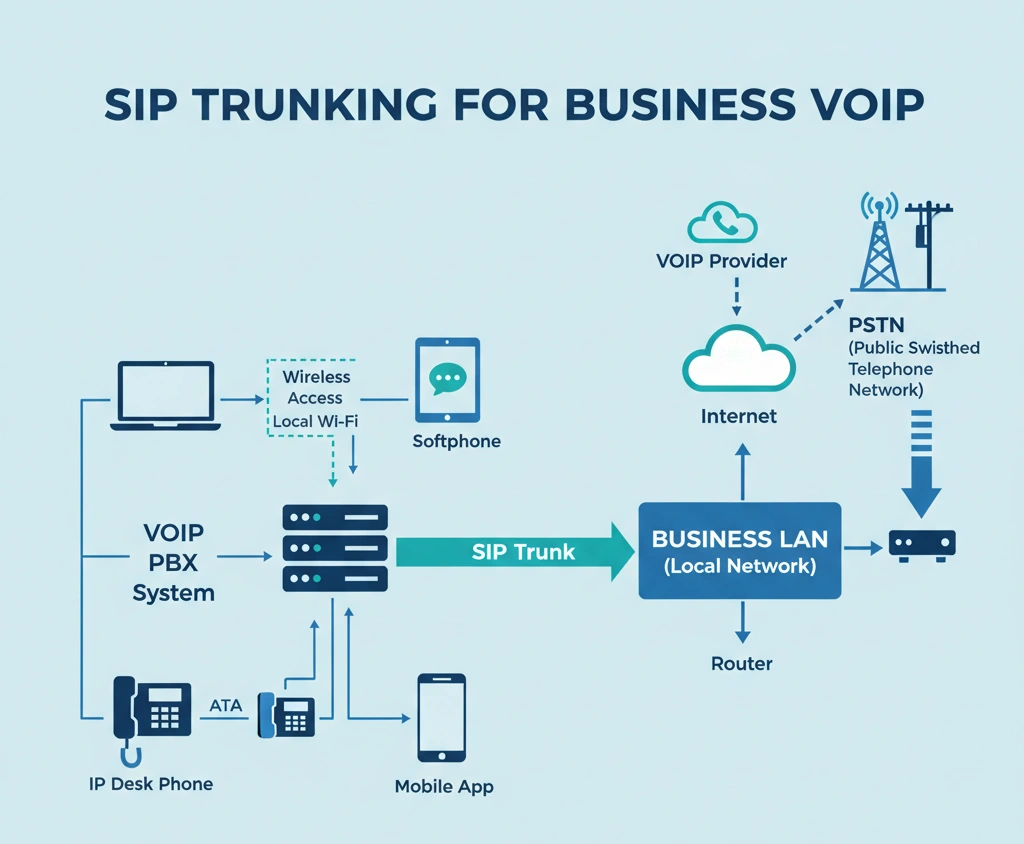
Benefits of SIP trunking include lower costs, easier management, and you can activate service immediately. Tech executives add a SIP trunking provider to add new voice capabilities to an existing phone system.
- Copper wiring charges
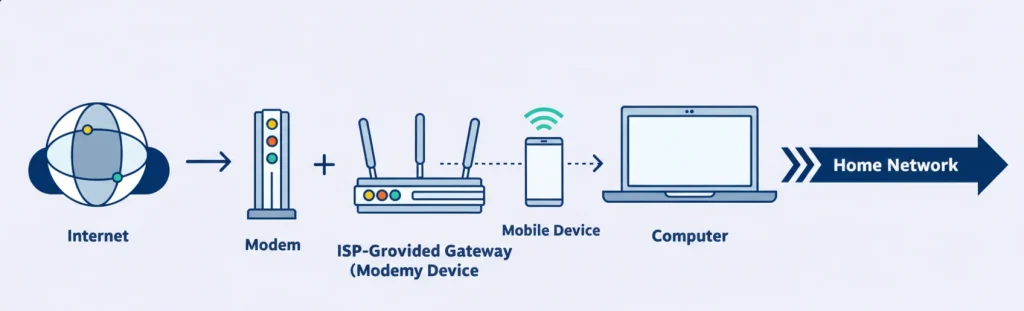
Broadband connections also throw out extra wiring because VoIP networks allow both voice and data on the same channel. In IT and telecom circles, the correct word for this is full-duplex (double-way communication). It’s basically the ability to send and receive voice and data all at once. Most VoIP desk phones need only one Ethernet cable to be connected to it.
What’s Power over Ethernet (POE)?
Power over Ethernet enables offices to be more modular with their office staff. Moreover, those offices won’t need to make changes to the buildings electrical wiring or anything.
- Calling expenses
Direct costs also come in the form of the cost of calling. VoIP calls are less expensive compared to the Public Switched Telephone Network (PSTN) or traditional circuit-switched telephone network by a stretch.
This mainly has to do with a fall in data carriage costs. Initially, data was priced out of reach of small businesses, but for bigger organizations, users had to face the capping on the organization’s internet bandwidth and broadband. These days, indeed, internet speed has improved, but data costs have taken a drop.
Statistically shown that small businesses using VoIP can reduce their company’s phone bill by up to 60%, besides that, they can save up to 90% on international calls. One easy way out is to choose the right business phone service and VoIP provider. We have some amazing ip phone accessories that you might be looking for, accessories that can boost both compatibility and overall performance of your existing system.
- Recurring Expenses:
A VoIP service also allows businesses to cut other ongoing expenses such as taxes, repair, and maintenance fees. VoIP providers usually roll these costs into subscription plans, which cost little per month.
All these costs, combined, make VoIP service an appealing proposition for growing startups and SMBs.
2. Indirect Cost Savings:
Indirect savings are more difficult to count, but that doesn’t make the many less critical for your business. Underneath are some of the most common areas where organizations save money long-term.
- Savings with remote work:
Switching to VoIP lets employees stay connected to the corporate phone system while working remotely. This is due to a long list of VoIP phone features like call waiting, auto-attendant, instant video calling, conference calling, and others not provided by traditional phones.
It can serve as a clean space for employees due to its minimal clutter of cables, and helps boost the team’s productivity as it better aligns with the daily tasks.
- Repurposed manpower:
If you have hired a full-time secretary for receiving calls, and walk-ins, etc., then the auto attendant feature lets you repurpose that role without any additional cost. Hiring an assistant might be difficult for new businesses, but with an auto-attendant feature a click away, you can wave off huge costs.
- Cost-free Add-on features:
Traditional PBX features don’t support remote working via functionalities like call transfer, group ringing, call queuing, and so on but you need to pay for these add-on features. By comparison, VoIP phone services include many of these features at no additional cost. No need to spend extra money on whatever feature you think could be useful for your business.
2. Increased Accessibility:
Other than cost, accessibility is another huge benefit of VoIP. One clear-cut advantage is a cloud-based VoIP service through which you can call from anywhere. If you have a nice data connection, you can easily make and receive calls, and you can also direct calls to another person or get voicemail emails to you. A notable benefit of VoIP is the ability to take your business phone with you, nothing more than a softphone app.
VoIP adapts based on how your employees work. Employees don’t need to be physically present at the office. They can work from smartphones or tablets from anywhere.
3. Complete portability:
Your number, which is also known as a virtual phone number, is completely portable. This means you can use the same number wherever you go. Its a good news for people who travel a lot. Other than that, in the event your business changes address, you can retain the same VoIP number.
4. Higher Dependability:
Scalability is the most prominent feature of the best small business voip phone system, especially for growing businesses. No matter what scenario, toggle your preferences immediately without any need to purchase additional lines or dedicated hardware.
5. Clear Voice Quality:
In the beginning, when the best voip phone systems for business were introduced, the main issue was call quality. Calls would suddenly drop, call quality wasn’t up to the mark, and latency was the order of the day.
The main key to VoIP call quality is a nice, stable connection with good bandwidth. Without this, it can be a nightmare, especially if you often find yourself making calls at the same time. There’s always someone who calls in with a cell phone, and everyone else suffers through echoes, delays, and background noises. VoIP phones end those interruptions so you can make and hear calls in peace and focus on the meeting’s agenda. A combination of noise-cancelling microphone and advanced audio compression allows VoIP phones to achieve superior sound quality.
6. Supports Multi-tasking:
In addition to traditional phone calls, VoIP allows you to send documents, images, and video, and to engage in conversation. Ideally, you can hold more engaging meetings with clients or staff from other companies worldwide. For further IP Phone features, we have discussed them in detail so you can make an informed decision for your business’s future.
VoIP Cons:
Here are some of the disadvantages of VoIP services you need to consider;
- Dependency on Stable Internet:
VoIP calls travel over your internet connection, so a reliable connection is needed for smooth operation. If your internet drops often, then expect choppy calls or even complete outages. A minimum upload speed of 100 kbps per device is recommended. While VoIP is efficient, low speeds can lead to dropped calls and lag.
Low latency (single delay) and jitter (variation in latency) can also impact call quality. Still, the best part is that VoIP uses less bandwidth than you might expect, so you don’t need any expensive internet phone service. A reliable plan should serve most users who work from home.
Types of Connections Best for VoIP:
- Fiber internet.
- Cable internet.
- DSL internet.
- LTE internet (cellular).
- 5G internet (cellular).
The two types of connections aren’t a good choice:
- Satellite internet.
- Dial-up internet.
For a bigger firm, it depends on how many calls are made side-by-side. The best way to find out is to run a bandwidth test on your current network to make sure you don’t face VoIP issues.
2. Latency and network Jitter:
Other than internet stability, the main issue is latency and network jitter. Latency and jitter happen when data packets experience delays during transmission, increasing the time it takes for information to arrive, and when packets take wrong turns or get stuck, causing delays and requiring re-transmission.
These can happen because of a crowded internet connection, outdated equipment, or worn cables. You can reduce it with some practices, such as:
- Upgrade your internet plan.
- Invest in a quality router.
- Check and replace worn cables.
- Enable jitter buffering.
- Limited location tracking for emergency calls:
One big difference between traditional phone lines and top rated voip phone systems is emergency calling. With a cell phone, emergency services can use cell data to locate you in an emergency. However, VoIP calls depend on IP addresses, which aren’t straightforward for location tracking.
- Compatibility issues with some traditional equipment:
Some of the older kinds of alarm systems and fax machines don’t work with top rated voip phone systems. There are two ways to address these issues:
- Upgrade equipment.
- Use an ATA (analog telephone adapter) is a converter that can convert analog signals from older equipment to work with VoIP.
Wonder why compatibility issues occur? Well, Traditional phone lines transmit analog signals, while VoIP uses digital data. This conversion process (modulation) can slightly convert the signal, causing problems with incompatible equipment.
- Security Risks:
Just like every other internet-based technology, top rated voip phone systems are also vulnerable to security risks such as hacking and phishing attacks. Hackers could potentially tap into calls, steal data, or disrupt service. What can you do to keep your business secure?
- Choose a reputable VoIP provider like Soglink, which is the most trusted online electronic gadget store.
- Educate and train your employees on VoIP security best practices, examples of how to identify phishing, and how to make strong passwords.
- Keep VoIP software and devices up to date with the latest security patches.
If you are still curious and want to look for more options and variety, then reach out to us; we will not only guide you through every problem but also work on your installation process. So that you enjoy the best of the best available in the USA.
✍️ Author’s Bio
This article is crafted by Spoglink’s Research & Content expert, with a group of technology specialists dedicated to helping U.S. businesses make smarter IT decisions. Our experts collaborate closely with IT managers, system integrators, and hybrid teams to evaluate cutting-edge collaboration tools from brands like Yealink, Grandstream, OWL Labs, Snom, TP-Link, and Ubiquiti Networks. Through hands-on testing in real-world business environments, the team delivers actionable insights and unbiased reviews—empowering organizations to choose the right technology for seamless communication, conferencing, and connectivity.
FAQS
1. What is the difference between SIP and VOIP?
SIP (Session Initiation Protocol) is basically a signaling protocol used to initiate, maintain and terminate real-time communication sessions like voice and video calls over IP networks.
On the other hand, VoIP (voice over internet Protocol) is a technology that allows voice communication over internet or IP networks. SIP is one of the protocols used to implement VoIP.
2. What is a SIP Truck Provider?
A SIP Trunk Provider provides SIP trunking services that connect your on-premises phone system to the public telephone network through the internet, replacing traditional phone lines with virtual ones.


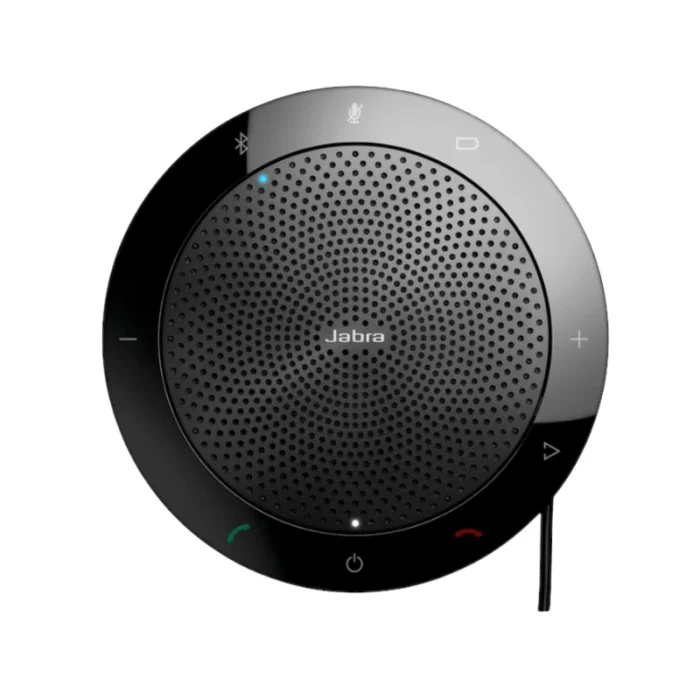 Jabra Speak 510 UC Speakerphone – 7510 – 209