

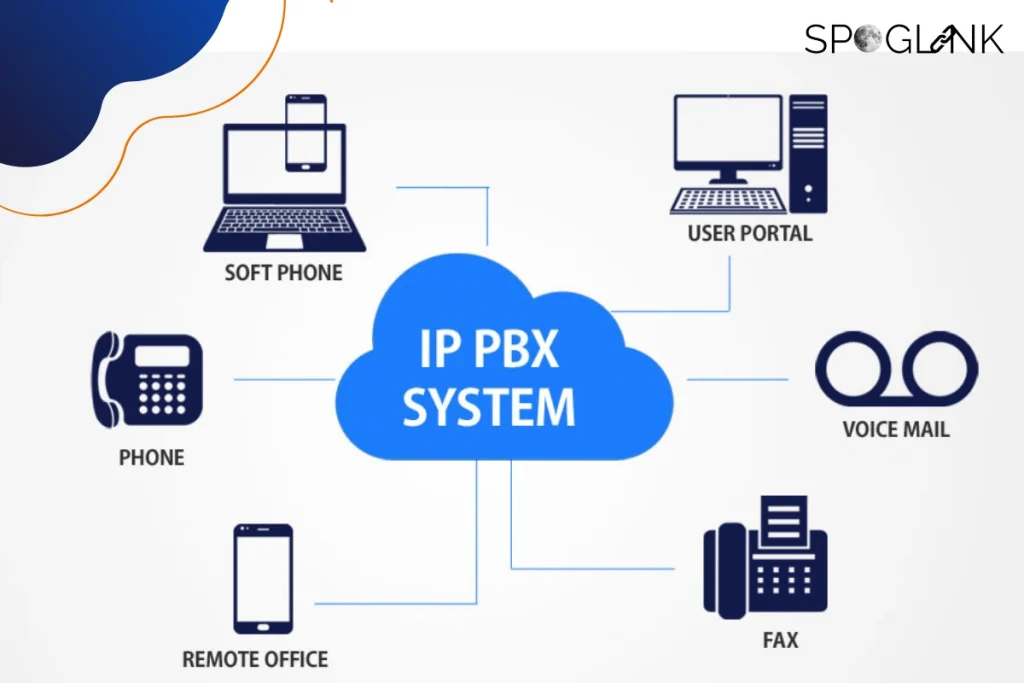
If you are thinking about setting up a new business phone system and you have so many options to choose from, an IP PBX is one of them. Many businesses exploring voip phone systems sacramento solutions often come across IP PBX as a flexible and scalable option for modern communication.
If you already have a Private Branch Exchange (PBX), moving to a cloud-based trunking provider for PSTN connectivity is worth considering.
It’s not as easy as you might think. After all, you don’t want to face new problems with incoming calls. In this guide, you’ll learn more about what an IP PBX is, IP-based phone solutions, how they differ from VoIP, and some limitations you should know before making a decision.
What is an IP PBX?
For those who are wondering, an IP PBX system is a telecommunications device that provides voice connectivity to desk phones within a building. It keeps an eye on the outgoing and incoming calls across its telephone network using an internet connection.
Let’s check the definitions separately.
- IP: means Internet Protocol (IP), which is a method of transmitting data to another server. This technology means that calls are established over the internet.
- PBX: A private Branch Exchange (PBX) is an internal telephone network. A PBX can exist on-premises, or you can host it securely in the cloud.
An IP PBX phone system can receive and make phone calls over the internet while maintaining analog phones throughout the office.
You can build a PBX using open-source solutions that require Linux knowledge. You should also know about call routing and comfort managing Asterisk-based PBX servers. There are many pros and cons to this approach. It’s not for everyone.
How Does an IP PBX Work?
IP PBX phone systems place and receive phone calls over the internet. It does so by converting analog voice signals into digital signals. From there, it directs calls to a VoIP service provider to manage the initiation and termination of every call.
At the core, IP-based voice service uses the Session Initiation Protocol (SIP). This universal protocol has become the standard for VoIP phone systems. For a PBX, you would use SIP trunking, which offers multiple voice channels.
On the inner side of a PBX, that remains unchanged. Users can call each other, check voicemail, and set up call groups as they could before. It’s by design.
On the outer side of a PBX, a VoIP provider would give a set of credentials for one or more SIP trunking accounts. Once authenticated, incoming calls are presented to your PBX to accept. Users can also reach an outside phone line automatically via your SIP trunk.
The PBX itself determines if calls are handled internally or relayed over to the PSTN.
You should know its limitations, but first, here are the advantages of adding a VoIP gateway to your PBX.
Benefits of IP PBX Phone System
Adopting an IP PBX in your business can come with some perks. Here are some reasons why it’s a wise investment.
- Lower communication costs:
Internet-connected PBXs can provide much higher cost savings than their analog predecessors. VoIP providers like Nextiva offer both metered and unmetered trunking services.
- Cloud-based reliability:
Connect your existing PBX to the proven reliability of the cloud. A reliable VoIP service will have multiple data centers for dependable performance. Even if your PBX goes down, they can route calls elsewhere.
- Keep existing hardware:
You can keep everyone productive and keep your hardware costs low by using the same hardware that’s already attached to your PBX. The only thing you need is your SIP address, password, and domain, and you’re set.
- Minimal change:
Change can be intimidating to many businesses. Look to SIP trunking as a gateway to experiencing the value of a VoIP phone system. As your company grows, you can scale up the number of voice channels with minimal configuration.
Suppose you or your IT staff are already familiar with PBX phone systems. In that case, an IP PBX could be a smart stop-gap solution. Additionally, SIP trunks are location-agnostic, so you can get up and running in record time if you move offices.
Limitations of IP PBX Systems
Not every company is well-positioned to use an IP PBX. Here are some drawbacks to consider before you make the switch.
- Technical skillset:
Managing an on-premises PBX isn’t for the faint of heart. Systems administrators should be comfortable installing and configuring Linux operating systems. Experience with FreePBX or Asterisk open-source software is a must.
- Unable to work remotely:
Even with IP connectivity, most on-site PBX phone systems cannot support remote work. In 2021, this capability is a must-have for remote employees. This functionality can be as easy as downloading an app to your Android or iPhone and signing in.
- Limited scalability:
An IP PBX is only as scalable as the number of users who can answer phone calls. As your team grows beyond what your PBX can handle, you’ll face challenges, such as busy signals.
- Fewer features:
Traditional office phone systems lack the features found in a Unified Communications (UCaaS) platform. Video conferencing, softphones for mobile devices, and instant messaging are separate. Most small businesses don’t have the time and resources to configure these one by one.
What are the different types of IP PBX for small businesses?
Not every IP PBX system is made the same way or serves the same purpose. Your arrangement options depend on your technical resources, adaptability needs, and whether you prefer full control or hands-off management. Most businesses choose between on-premises, cloud-based, or hybrid systems.
Hosted or Cloud-based IP PBX systems:
A hosted IP PBX system is managed by a third-party provider and runs on cloud infrastructure. Businesses access it over the internet through VoIP apps, softphones, or IP desk phones, without the need to manage servers or hardware locally.
This setup offers easy adaptability, built-in redundancy, and fast deployment, making it a strong option for growing or remote-first teams.
Usually, cloud-based systems often include automatic updates, lower upfront costs, and feature-rich portals that align and simplify user management.
On-premises IP PBX
On-premises systems are manually installed and managed at your business location. The hardware connects to your internal network and might use your existing desk phones, routers, and servers. Because all is managed in-house, you have full control over setup, security, and customization.
Still, this approach needs internal IT expertise and ongoing maintenance. Adding new users or features can involve manual upgrades and setup.
Hybrid IP PBX solutions
A hybrid IP PBX blends on-premises infrastructure with cloud-based functionality. Let’s suppose you may use in-office servers for core call routing while connecting to a VOIP provider for remote access, failover routing, or advanced features.
This option provides you with control of non-premises hardware with some of the flexibility of a cloud-based solution, perfect for businesses in upgrading or with mixed operational needs.
IP Pbx vs traditional pbx What is the Difference?
IP PBX systems use internet connectivity (VoIP) to give superior adaptability, advanced features like video/chat, and remote work support, making them more flexible than traditional PBX, hardware-based PBX systems. Traditional PBX systems use manual, on-site copper wiring and analog lines, which are generally more expensive to maintain and are limited to office-only usage.
Main difference between IP PBX and Traditional PBX
- Technology and setup:
IP PBX uses Internet protocols and data networks. However, in IP Pbx vs traditional PBX, traditional ones rely on copper lines (PSTN) and on-site, manual hardware.
- Cost:
An IP PBX offers less setup and maintenance, as well as lower call costs, particularly for long-distance calls. Traditional PBX has higher initial investments and expensive, fixed-line rentals.
- Adaptability and Flexibility:
IP PBX allows for easy addition of users or virtual, remote extensions. Traditional PBX is very limited to manual hardware, making expansion and adaptability very difficult and costly.
- Features:
IP PBX offers unified communications, including video conferencing, voicemail-to-email, instant messaging, and CRM integration. Traditional PBX is limited to basic calling functions.
- Dependability:
Traditional systems are unaffected by internet outages, but IP systems depend on network stability. However, IP PBX offers better disaster recovery, as it can be hosted in the clouds.
Which business voip phone system to choose from?
To understand what is an ip pbx and choose from one that suits your needs the most, here’s a short description that might help you understand easily:
- Choose IP PBX:
If you are working with a remote team, you want better adaptability, lower costs, and advanced integration with modern software.
- Go for Traditional PBX:
Only if you have highly stable, non-Internet-dependent requirements, or if you already have the infrastructure and do not require modern, flexible, or hybrid working features.
Contact us to get the IP PBX phone system that serves the best for your business needs and progress.
FAQS
1. Can I use my old desk phone with an IP PBX?
Yes, many systems allow using existing hardware by using SIP trunks, although IP desk phones, softphones, and mobile apps are typically used.
2. What will I do if the internet goes down?
In that scenario, calls may fail in on-premise systems. But, cloud-based systems usually have a backup system to route calls to mobile devices or alternative locations, guaranteeing business continuation.
3. How secure are these IP PBX systems?
They may be subjected to internet threats, but they can also be very secure when proper protocols are followed, which includes using firewalls and encrypted VoIP traffic.


